Vertical Purification from Industrial Scale to Precision Grade
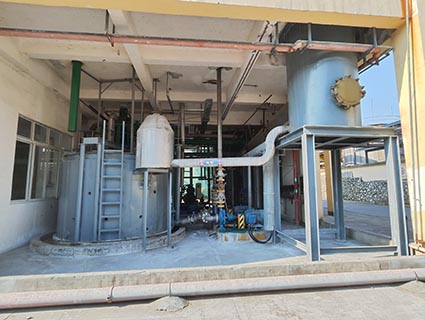
One of Goway’s defining strengths is our ability to connect large-scale phosphate production
with high-purity refinement.
Backed by a group-wide production capacity of more than 200,000 metric tonnes per annum,
our team works on top of a substantial industrial foundation. This manufacturing depth provides
a unique advantage: it gives us access to broad process knowledge, production data, and raw
material control that can be translated into specialized purification and upgrading pathways.
Our R&D team uses this foundation to support the transition of selected phosphate streams
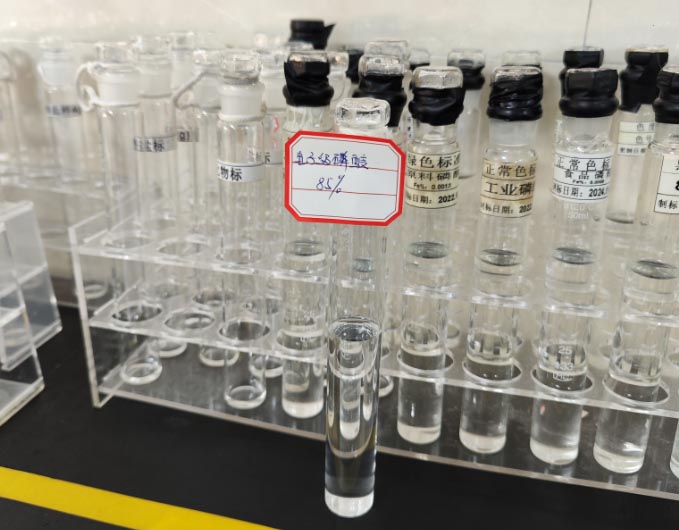
from industrial-grade or food-grade processing toward more demanding specifications, including
products intended for battery-grade and other high-purity applications.
This capability requires more than conventional production know-how. It depends on controlled
process design, impurity management, stage-by-stage refinement, and tight analytical verification.
Analytical Science and Quality Control
Precision phosphate chemistry depends on measurement.
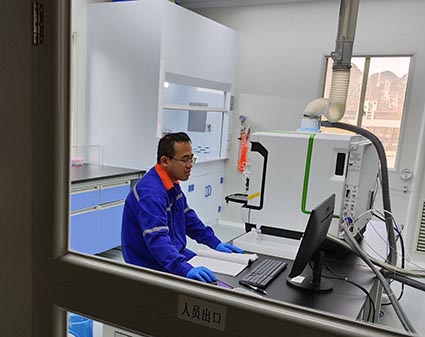
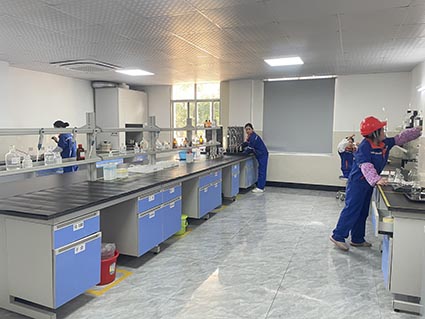
Our team relies on advanced analytical methods to verify purity, identify trace contamination
risks, and maintain batch-to-batch consistency. A key part of this capability is the use of
ICP-MS (Inductively Coupled Plasma Mass Spectrometry) for trace metal analysis,
enabling control at ppm and, where required, ppb-level sensitivity.
This is especially important in battery-material applications, where trace elements such as
calcium, magnesium, sodium, copper, and zinc can influence electrochemical performance even at
very low concentrations.
- Trace metal screening and impurity profiling
- Batch-level consistency verification
- Process optimization based on analytical feedback
- Application-specific quality evaluation
- Documentation support for technical qualification
Multi-Industry Application Knowledge
Our team is not limited to laboratory chemistry alone. We combine phosphate science with
application knowledge across multiple downstream industries.
This means we do not simply ask whether a phosphate product meets a specification on paper.
We ask whether it will perform in a customer’s actual process, formulation, or end-use environment.
- Battery precursor preparation and purity-sensitive material systems
- Food processing functionality and formulation consistency
- Ceramic processing and additive compatibility
- Industrial treatment systems and cost-performance optimization